The Human Skills AI Can't Replace in 2026 Are Mostly Taste
Every career listicle names the same eight soft skills. The one that matters when you're staring at a ChatGPT draft is narrower: taste, the judgment to tell good output from convincing output.
MDCrafter Team
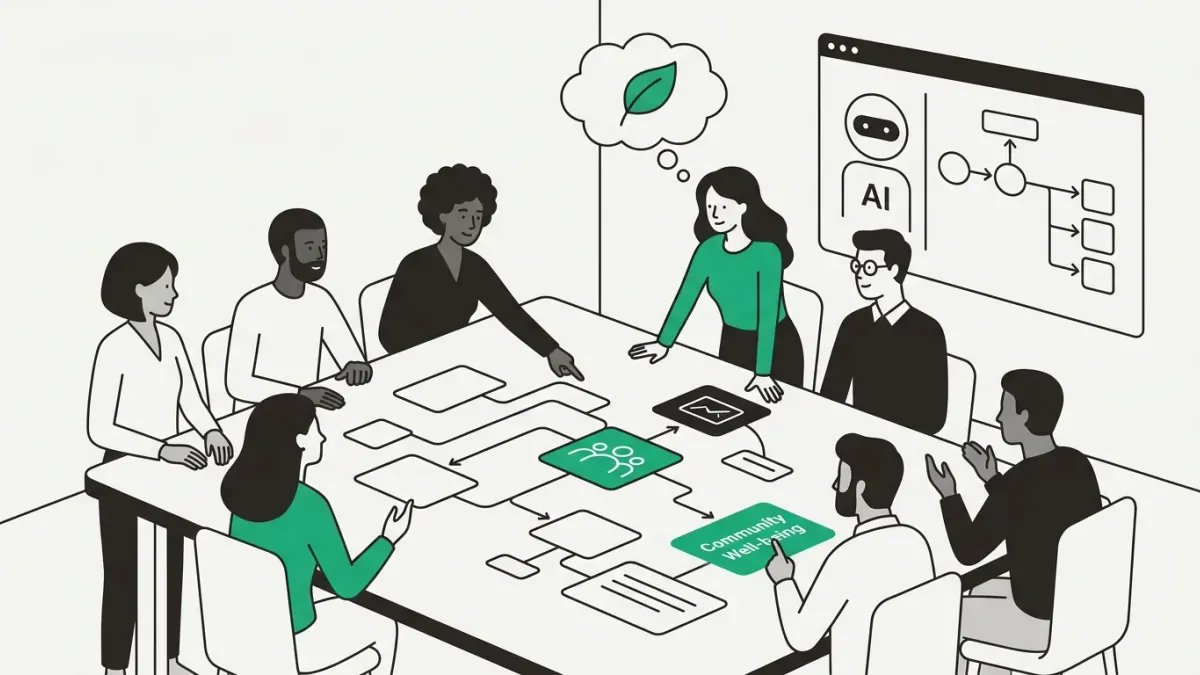
Search for the human skills AI can't replace in 2026 and every result hands back the same eight nouns: empathy, creativity, critical thinking, adaptability, leadership, communication, ethics, curiosity. None of it is wrong. All of it is useless the next time you're staring at a ChatGPT draft that reads perfectly well and is somehow still not right.
The version of this question worth answering is smaller and much more immediate. When you sit down with Claude or ChatGPT tomorrow morning, which part of the job is still unavoidably yours?
Every list of human skills AI can't replace says the same thing
LinkedIn CEO Ryan Roslansky has been pushing a framework he calls the five Cs: curiosity, courage, creativity, compassion, communication. Young workers, he says, can't afford to overlook them. Fine advice. Now try to practice courage on a Tuesday afternoon between two Slack threads.
The crowdsourced answers are even softer. Scroll the Quora threads titled 'Which human skills will AI never replace' or 'What's ONE skill AI will never replace' and the responses collapse into a loop: empathy, moral judgment, and 'the human element.' Which is roughly the claim that AI can't be human. True, and completely unactionable.
ClearanceJobs at least brought numbers, estimating that AI can automate only about 31% of leadership duties and pointing at negotiation, coaching, and public speaking as categories still attached to millions of open job listings. Useful for a career pivot. Still no help at all with the thing in front of you, which is a 600-word draft that needs a decision.
Sam Altman's answer is one word
The day before OpenAI announced its funding round, Sam Altman described how he hires: 'We believe the best research teams are built through context, taste and a real feel for where the field is headed next.' Taste, sitting there in the middle of a hiring criterion at the company building the models everyone's worried about.
That's more interesting than another soft-skills list, because taste in that sentence isn't a personality trait. MindStudio pinned the working definition down well: taste is your ability to evaluate AI outputs, the judgment that tells you when something is close, when it's off, and what 'good' actually looks like in your domain. Curt Doty put the same idea more bluntly on Substack: 'AI is powerful. But it doesn't come with taste.' His argument is that once everyone has the same tools, prompts are just inputs. The editor behind them decides whether the output is worth anything.
What taste looks like inside a ChatGPT window
Strip away the abstraction and taste is a set of small, boring decisions you make dozens of times a session. It's the two seconds where you read a paragraph and think, that's the generic version. It's knowing that the model's third suggestion is the one your actual audience would care about, and the first two are what an average of the internet would say.
- Recognizing that a draft is structurally fine and tonally dead, and being able to say which sentence killed it.
- Knowing which of five suggested headlines your specific readers would click, without running a test, because you know them.
- Catching the confident paragraph that's subtly wrong about your industry, when nothing about the writing signals doubt.
- Deciding to throw out an output that took four rounds of prompting, because sunk cost isn't a quality standard.
- Noticing what the model left out entirely, which is the hardest one, because absence doesn't announce itself.
The model never questions the premise
There's a code review finding that captures this better than any soft-skills framing. AI-suggested code changes get adopted at 16.6%. Human-suggested changes get adopted at 56.5%. The explanation isn't that the AI writes worse code. It's that human reviewers challenge assumptions about the problem itself, while the AI never questioned the premise, only the implementation.
That gap generalizes past code. Ask a model to improve your onboarding email and it will improve your onboarding email. It will not ask whether you should be sending one. A colleague might.
You can watch practitioners argue about exactly this on Blind, where a thread about juniors versus seniors in the AI era has one engineer flatly claiming AI is smarter than humans, and another pointing out that writing code was never the hard part. Understanding what the code actually does is. That's the whole disagreement, and it's the same disagreement in every field where AI can now produce plausible first drafts faster than anyone can check them.
Critical thinking and AI don't automatically coexist
Now the feedback loop that makes this worse. A Microsoft Research finding that's been cited widely over the last year reports an inverse correlation between confidence in AI output and critical-thinking engagement. The more you trust the model, the less you interrogate it.
Which means taste erodes exactly when the tool gets good. Bad AI output kept you sharp because you had to fix everything. Good AI output invites you to skim, approve, and ship. The skill doesn't disappear because a model replaced it; it atrophies because you stopped using it.
AI-proof skills in 2026 are habits, not traits
If taste is judgment applied to output, it's trainable, and it trains the same way any judgment does: through reps with feedback. A few habits that keep it alive:
- Decide what good looks like before you prompt. Write the acceptance criteria first, even one line of it, so you're evaluating against a standard instead of against your own tiredness.
- Read the first draft as a reviewer, not a recipient. Ask what's missing and what assumption the model quietly accepted, not just whether the prose flows.
- Keep one task a week fully manual. Draft the thing yourself. It's the only reliable way to notice that your internal bar has drifted toward the model's average.
- Reject more. If you never throw out an output, you're not exercising judgment, you're rubber-stamping.
- Get the premise checked by a person. That's the thing the AI provably won't do for you.
Is your job AI-proof? Wrong question
The listicles frame this as a defensive exercise: stockpile the skills the robots can't do and hope your title survives the reorg. That framing has it backwards. Nobody gets paid for having empathy in the abstract. They get paid for shipping work that's right, and in 2026 an increasing share of that work arrives as a confident draft that someone has to judge.
The people doing well with these tools aren't prompting harder. They know what good looks like in their domain, and they're willing to say no to output that doesn't reach it. That's the skill. It was always the skill. AI just removed every excuse that used to hide it. Training that judgment is a lot easier with a library of tested prompts to compare your own output against, which is the whole idea behind MDCrafter.
References
- Yahoo Finance - "Have good taste? It may just get you a job during the AI jobs apocalypse, says Sam Altman"
- MindStudio blog - "Taste vs Conviction: AI-Assisted Work Skill Gap"
- Curt Doty (Substack) - "What Happens When Everyone Has AI - but No One Has Judgement?"
- ClearanceJobs - "The Human Advantage And 10 Skills AI Still Can't Replace"
- CNBC - "LinkedIn CEO: Young people 'can't afford to overlook' these 5 skills that AI can't replace"
- arXiv - "Human-AI Synergy in Agentic Code Review" (AI vs. human code-suggestion adoption rates)
Enjoyed this? Get the weekly craft.
One crafted prompt in your inbox each week, with the reasoning behind it.
Free. Unsubscribe anytime.
Keep going
More to read
Guide
Choosing the Right AI Tool for Your Task
There's no single best AI assistant, only better and worse fits for a specific job. Here are the six criteria that actually decide it, plus a fast test to confirm your pick.
Prompt
Explain a Concept in Multiple Formats Until One of Them Finally Clicks
Takes the concept you have reread five times and explains it as an ELI5, plain English, the formal exam-ready version, an analogy with its limits, a diagram to draw and a worked example, then checks which parts landed. Once the concept clicks, move to our step-by-step problem solver to prove you can use it, not just describe it.
Article
The AI Productivity Paradox Is Mostly a Prompting Problem
Studies keep finding AI adds work instead of saving it. A surprising share of that hidden tax isn't the model's fault - it's how we prompt.